
If you have heard of "flexible mesh led screens" for the first time, but are responsible for purchasing a few thousand square meters outdoor large screen in 2025, this article is a tailor-made "life-saving document" for you.
After reading this article, you will thoroughly understand:
What is a flexible mesh screen? What is the difference between traditional outdoor screens?
1.What is a flexible mesh screen?
Four simple words: a glowing screen window.
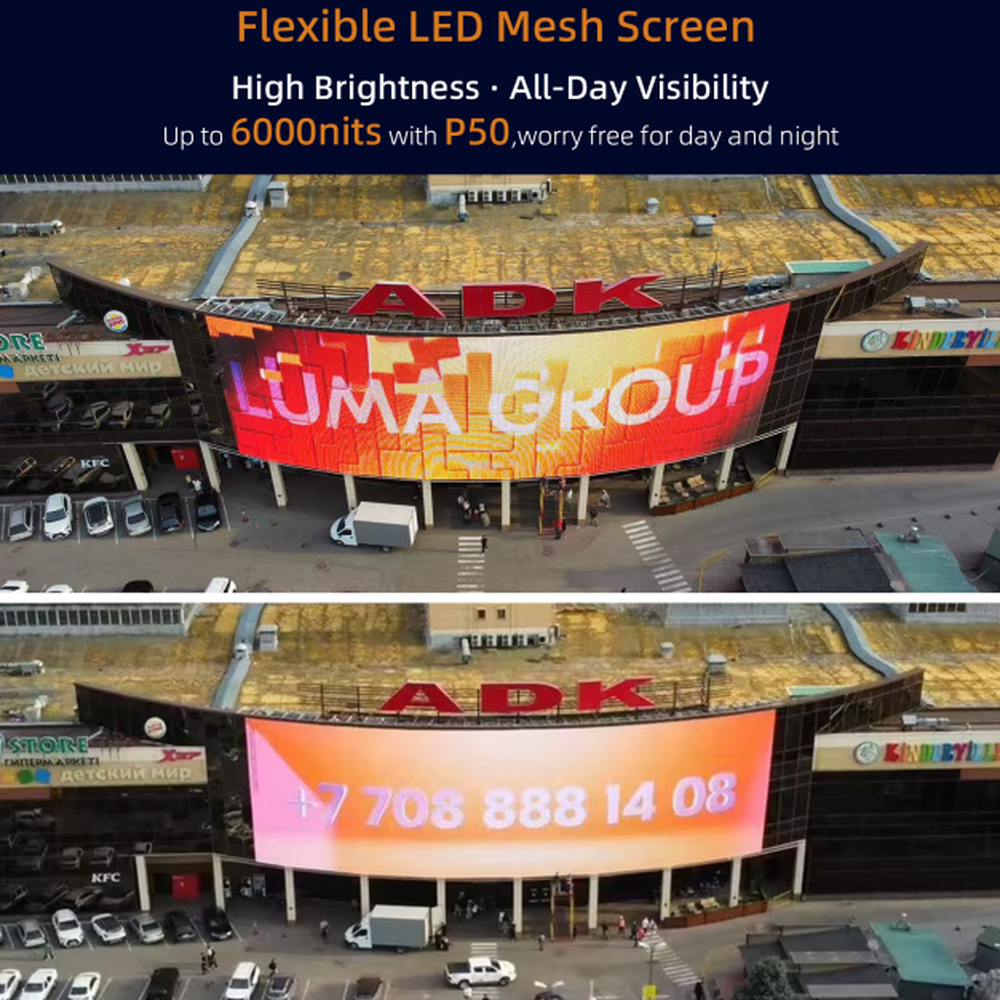
It is a huge "LED mesh" that can be rolled up, breathable, lightweight, and bent at will. It is almost invisible during the day, but at night it can display videos, animations, and text, like giving the building a layer of breathing glowing skin.

2.What is the difference between it and traditional outdoor screens?
| Item | Traditional outdoor box screen | Flexible mesh screen |
| weight |
35-65kg/㎡ |
1.2-10kg/㎡ |
| transmittance |
0-30% |
30-90% |
| Installation method | Must have a steel structure | No,Installation of steel wire buckle |
| Can it be rolled up for transportation | No | Yes,Like rolling curtains |
| Can we stick a curved surface | No | Yes,Feel free to paste, spherical or wavy will do |
| heat dissipation | Fan+air conditioner | Natural wind penetrates and dissipates heat |
|
lifespan |
30000H | 50000H |

3.Who is buying in 2025?
Real estate developers (renovating old buildings for night lighting), urban investment companies (urban renewal), advertising agencies (landmark media), cultural and tourism groups (night tour projects), design institutes (integrating building facades), and municipal governments (using glass curtain walls for media) - almost all clients who do not want to add steel structures, block natural light, and have limited budgets are turning to led mesh screens.
8 core parameters that purchasers must memorize in 2026
1. Pixel Ptich (P-value) - determines "unclear visibility from a distance"
Mainstream outdoor grid screen spacing in 2026: P31.25, P40, P50, P55, P80, P100, P125, P150
Best clear viewing distance (meters)=pixel ptich (mm) × K value
The K value is divided into three levels according to the actual application scenario:
a. Coefficient K=0.8: High definition display with clear text (close-up);
b. Coefficient K=1.1: Outdoor display screen, clear video (standard city view);
c. Coefficient K=1.5: Billboard, grid screen, large image, large text display (distant view).

Quick lookup table for optimal viewing distance of led grid screens with different ptich:
| Pixel Ptich | Close up recommendation (K=0.8) | Standard recommendation (K=1.1) | The most commonly used long-term recommendation (K=1.5) |
|
P31.25 |
25m |
34m | 47m |
| P40 | 32m | 44m | 60m |
| P50 | 40m | 55m | 70m |
| P55 | 44m | 60m | 82m |
| P80 | 64m | 88m | 120m |
| P100 | 80m | 110m | 150m |
| P125 | 100m | 137m | 187m |
| P150 | 120m | 165m | 225m |
2. Transparency - determines whether to be invisible during the day
| transmittance | Daytime visual effects | Indoor lighting impact |
| <30% | Clearly visible mesh screen | Decreased lighting by 70%+ |
|
30%-60% |
I can see something | Decreased lighting by 40%+ |
|
60%-80% |
From a distance, it appears almost invisible | Decreased lighting by 20%+ |
|
80%-90% |
Completely invisible, as if without any disguise | Decreased lighting by 10%+ |
3. Brightness - determines whether one can see clearly under the sun
Ordinary box screen: claimed 10000nit, tested 7000-8000Nit
Top led grid screen: Tested to stably output 9000-15000nit (due to good ventilation and heat dissipation)
Remember one sentence: Grid screens, due to natural convection heat dissipation, dare not turn on the lights even if the brightness is fully turned on.
Under the same lamp bead conditions, the grid screen has a true brightness that is 40% -80% higher than the box screen.
4. Softness (bending radius) - determines whether it can adhere to curved surfaces
Ordinary flexible mesh: convex bending radius ≥ 1.5 meters
Top notch grid screen: The concave convex bidirectional bending radius can reach 0.8 meters (including cylinders, waves, and spheres)
5. Weight - decide whether to add steel structure or not
Traditional box screen: 35-65kg/㎡ (requires steel structure)
Flexible led mesh screen: 1.2-10kg/㎡ (no steel structure required, directly attached to the original curtain wall)
6. Protection level - determines how many years it can be used
Do not accept led mesh screens below IP67 by 2025
Top factories have achieved: front IP68, back IP68, typhoon+rainstorm+54 ℃ exposure for three years without failure.
7. Power consumption - determines electricity bills and power capacity expansion
Traditional box screen: 780-950W/㎡
P50 led grid screen: 173W/㎡ (energy-saving 60% -70%)
8. Maintenance method - decide whether to cry later or not
The breakpoint continuation control method makes maintenance more convenient. If a pixel is damaged in the middle, it will not affect other lights. Simply replace the damaged light, and it will take 5 minutes to replace the damaged pixel
Why is everyone competing for flexible grid screens in 2025?
5 hardcore reasons why flexible mesh screens have become absolute kings:
●Golden visual distance of 30-200 meters, covering 90% of urban main road viewing scenes
●At the same clarity, the number of LED beads is only 1/4 of the traditional screen outside the house, and the cost is directly halved
●The light transmittance reaches 90%, with almost zero impact on indoor lighting
●Weight as low as 1.2kg/㎡, 99% of projects do not require steel structures
●Brightness easily breaks 6000nit, surpassing all traditional screens in seconds during the day
●One sentence: LED Grid screen is the most balanced answer in the four dimensions of "clarity, transparency, cost, and installation difficulty" by 2025.
The Ultimate List of Procurement Avoidance Pits in 2025

●Physical samples with a transparency rate of 90% or higher must be observed on-site
●Third party testing reports (brightness, transparency, IP rating) must be requested
●It is necessary to clarify the minimum replacement unit
●It is necessary to confirm whether roll to roll transportation is supported
Finally, in 2025, you only have one chance to choose the right one
2025 will be the year when flexible grid screens will completely explode.
Early entrants (2023-2024) have already benefited:
Shenzhen Futian old renovation project: using P50 grid screen, recouping costs in 3 years
An old building in Jing'an, Shanghai: Rent increases by 18% due to improved night views
Monument to the people's Liberation Mall in Chongqing: the passenger flow will increase by 4 million per year after reconstruction
The biggest advantage for new buyers in 2025 is:
●The technology has matured and the supply chain is stable,
●After all the old buildings are replaced with transparent grid screens,
●The one that hasn't been replaced is the most prominent 'black hole' in the city's night sky.
●Don't let your project become that black hole.