



What Exactly Is a Mesh LED Screen?
A mesh LED screen is an LED display built from spaced light strips or grid-shaped modules rather than a fully enclosed panel surface. The open construction allows some daylight and airflow to pass through while the LEDs form a coordinated image at the intended viewing distance.
The Grid Structure and How It Produces an Image?
LED pixels are mounted on narrow strips or interconnected grid units with deliberate gaps between them. Multiple units form modules, and the modules are assembled into a display of the required size. A controller distributes image data to receiving hardware, while a separate power network supplies the modules.

At close range, viewers may see the individual LEDs, strips and gaps. From farther away, the illuminated pixels visually combine into a coherent image. Compared with a conventional LED cabinet, a mesh screen uses less continuous surface material. However, openness, weight, rigidity and mounting method vary by product. Some systems can follow curved surfaces; others use rigid modules and a fixed supporting structure.
Mesh LED Screen, Grille LED Display and Transparent LED Screen - Are They the Same?
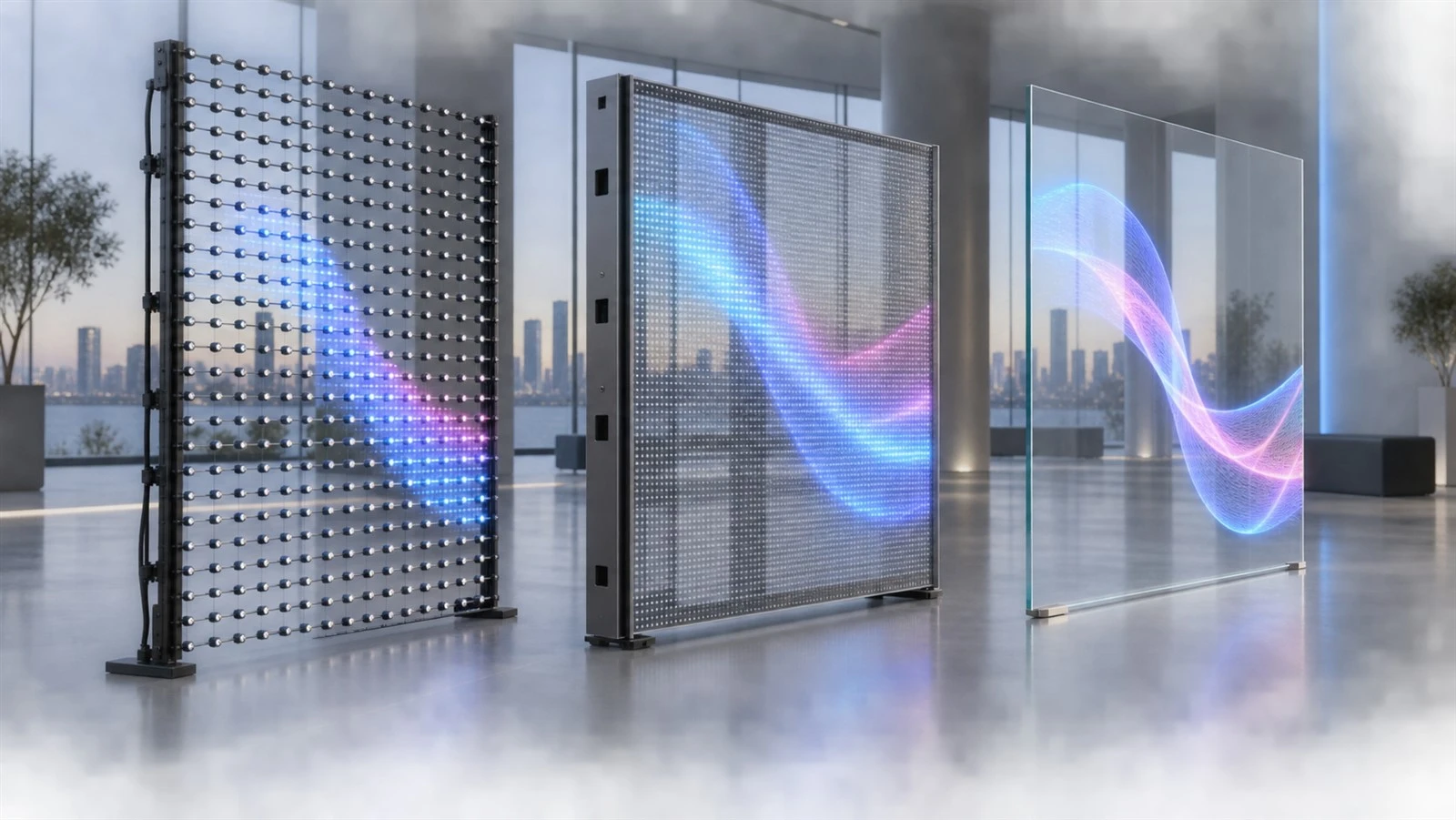
The terms are sometimes used interchangeably, but they are not universal product standards. Mesh LED screen and grille LED display often describe open structures made from spaced strips or grid modules. Transparent LED screen is broader and may include mesh systems, framed transparent cabinets or film-based products applied to glass.
|
Common term |
What it usually describes |
What buyers should confirm |
|
Mesh LED screen |
Open-grid display using strips or modules |
Structure, rigidity, open-area ratio and mounting method |
|
Grille LED display |
Often a strip-based outdoor display |
Pixel pitch, protection and module design |
|
Transparent LED screen |
Wider category of see-through displays |
Construction, transparency, brightness and intended environment |
Products with similar marketing names may differ greatly. Compare their actual structure, pitch, transparency, brightness, weight, IP coverage and installation method rather than relying on labels.
How Does a Mesh LED Screen Work in Real Projects?
A mesh LED screen operates as a system that combines a content source, display controller, receiving hardware, power distribution and LED modules. Compatibility among these components determines whether the assembled modules display one continuous image.
Image Control, Modules and Power Distribution
A typical signal path is:
Content source -> Sending controller -> Receiving system -> LED modules

The controller divides the image according to the screen layout, and receiving cards deliver the correct data to each module. Power supplies, cables and connectors form a separate network. Large installations require careful planning for cable routes, electrical protection, voltage stability and service access.
Why Viewing Distance Changes the Visual Result?
Viewing distance affects how clearly the grid and individual pixels can be seen. Pixel pitch is important, but the result also depends on open-area ratio, LED arrangement, screen size, brightness and content. Large text, bold shapes and high-contrast motion usually work better than small type, thin lines or detailed product images. Two products with the same nominal pitch can therefore look different in practice.

The Real Benefits - and the Trade-Offs
Mesh LED screens can solve practical problems in large-format projects, but every benefit should be checked against the installation environment and product configuration.
Benefits
Lower Weight Can Reduce Structural and Logistical Demands
Open modules may weigh less than many enclosed LED cabinet systems, reducing handling and transportation demands. Buyers should compare complete system weight in kg/m2, including frames, cables, power components and mounting hardware. A lightweight module does not remove the need for structural review.
The Open Structure Can Reduce the Area Exposed to Wind
Gaps allow some airflow to pass through instead of acting on a continuous surface. This may benefit facades, rooftops and other exposed sites. However, open-area ratio is not a substitute for project-specific wind-load calculations covering the modules, support frame, anchors and mounting position.

Transparency and Ventilation Can Preserve Building Functions
On a glass facade, the open structure may preserve part of the daylight, outward view and airflow. Greater openness can also reduce image density, so transparency should be assessed from inside and outside the building rather than accepted as a brochure percentage alone.
Modular Construction Can Simplify Transport, Expansion and Repair
Repeated modules make large screens easier to transport and configure. Faulty strips, modules or power components may be replaced individually, but actual serviceability depends on front or rear access, component design and safe technician access.
Large Display Areas Can Be Effective at Long Viewing Distances
Mesh LED is well suited to large visual surfaces viewed mainly from a distance. Its strongest content uses bold graphics, large text and clear motion. It is less suitable when viewers need to read fine detail nearby.
Power Consumption May Be Lower Under Comparable Conditions
An open display may use fewer LEDs per physical area than a denser screen, but power demand depends on pitch, brightness, content, driver design and operating schedule. Compare typical and maximum W/m2 only under reasonably similar conditions.
|
Benefit |
Practical effect |
What to verify |
|
Lower weight |
May simplify handling and reduce load |
Complete system weight |
|
Open construction |
May reduce effective wind exposure |
Open-area ratio and structural data |
|
Transparency |
Can preserve light and outward views |
Measurement method and interior impact |
|
Modular design |
Supports component replacement |
Service direction and access |
|
Large-format visibility |
Effective for distant audiences |
Pitch, content and viewing positions |
|
Potentially lower power |
May reduce operating load |
Typical and maximum W/m2 |
Where Mesh LED Works Best - and Where It Does Not?
Mesh LED performs best when openness solves a real project constraint. Suitability depends on viewing distance, content, structural capacity, exposure and maintenance access.
Building Facades and High-Rise Media
Large facades often require extensive coverage, long-distance visibility and partial transparency. On glass buildings, a mesh structure may preserve daylight and views while reducing weight and continuous wind exposure compared with a solid display.
Before approval, confirm facade capacity, wind requirements, anchor locations, service access, power and data routes, lifting needs, interior sightlines, nighttime brightness limits and local permits. Product specifications and building conditions must be evaluated together.
Concerts, Stages and Temporary Events
A stage mesh LED screen can add digital content without creating a fully solid backdrop. Lighting, scenic elements and backlighting can remain visible through the open structure. It may also be combined with conventional LED screens that handle close-up video, sponsor graphics or detailed text.
Rental systems should be evaluated for module and frame weight, transport cases, assembly speed, alignment after repeated use, connector durability, rigging points, control compatibility and spare parts. The full suspended load must include frames, cables and rigging hardware. Outdoor events also require suitable weather protection.
Stadiums, Landmarks and Public Spaces
These applications prioritize long-distance recognition, clear composition and reliable outdoor operation. Required brightness depends on orientation, sunlight, shade and operating hours. Excessive nighttime brightness can cause glare or conflict with local rules, so automatic dimming and time-based profiles may be necessary.
Environmental review should cover temperature, humidity, rain, drainage, UV, corrosion, wind, grounding, public safety and emergency access. Maintenance planning is critical when repairs require lifts, road closures or event shutdowns.

Poor-Fit Scenarios
Mesh led screen is generally a weaker choice when close-range detail matters more than transparency or scale.
|
Project requirement |
Mesh LED fit |
Main concern |
Alternative to evaluate |
|
Close-range retail content |
Low to moderate |
Grid remains visible |
Fine-pitch transparent cabinet or film |
|
Menus, prices or small text |
Low |
Dense information is difficult to read |
Fine-pitch LED or LCD signage |
|
Detailed product imagery |
Low to moderate |
Limited fine detail |
Conventional LED wall |
|
No transparency requirement |
Low |
Open structure offers little value |
Conventional outdoor LED |
|
No safe maintenance access |
Low |
Repairs may be difficult |
Front-service display or another position |
|
No structural approval |
Not ready |
Product selection cannot replace engineering |
Complete site assessment first |
How to Choose the Right Mesh LED Screen Specification?
Selection should begin with project conditions rather than a supplier catalogue. Each step narrows the next decision.

Step 1 - Define Viewing Distance and Content
Record the minimum, primary and maximum viewing distances. Also identify whether viewers are stationary, walking or travelling in vehicles. Moving audiences need simpler layouts, larger elements and shorter messages.
Define the content before discussing pitch. Logos and high-contrast animation need less density than small text, live video or detailed product imagery. Record operating times and whether the screen will be filmed, as camera use can add refresh-rate requirements.
Step 2 - Select Pixel Pitch
Pixel pitch is the distance between neighboring LED pixels. A smaller pitch generally increases image density, but may also reduce transparency and increase weight, power demand, control capacity, cost and the number of service points. Some mesh products have different horizontal and vertical pitches, so buyers should confirm both values and the total screen resolution.
Do not select pitch from a fixed distance formula alone. Ask for comparable project images, representative content simulations and, for high-value projects, a sample viewed from the intended distances.
Step 3 - Balance Transparency and Image Density
Larger gaps preserve more light and background visibility but provide fewer image-forming elements. Glass facades may prioritize daylight and outward views; solid walls may benefit more from image density.
Ask whether the stated transparency is a physical open-area ratio, measured light transmission or another calculation. Review a sample from inside and outside and under daytime and nighttime conditions. The goal is not the highest percentage, but enough openness without compromising the required image.
Step 4 - Match Brightness to the Environment
Specify brightness according to orientation, direct sunlight, surrounding shade and operating hours rather than the highest available nit value. Confirm normal operating brightness, nighttime limits and automatic dimming. Excessive output can increase power use, heat and glare without improving visibility.
Step 5 - Verify Outdoor and Structural Requirements
Confirm what the IP rating covers and request the relevant report. Review temperature, humidity, UV, rain, salt or corrosion requirements where applicable. Obtain module dimensions, fixing details, open-area ratio, wind data and complete system weight for local engineering review.
Define front or rear service access, redundancy, spare parts and replacement lead times before production. Review the datasheet, test reports, system diagram, maintenance plan, warranty and compliance documents before approving the order.
Mesh LED Screen vs Other Display Technologies
Technology should be compared against the project rather than one headline specification. Exact performance remains model-dependent.
|
Factor |
Mesh LED |
Conventional outdoor LED |
Transparent LED cabinet |
Transparent LED film |
|
Typical viewing |
Large, distant viewing |
Wide range, pitch-dependent |
Medium or closer viewing |
Close-to-medium viewing |
|
Transparency |
High to moderate |
None |
Moderate to high |
High |
|
Outdoor brightness |
Available by model |
Commonly strong |
Environment-dependent |
Often used behind glass |
|
Structure |
Open and relatively light |
Solid and generally heavier |
Framed modules |
Very lightweight |
|
Pixel pitch |
Commonly larger |
Wide range |
Often finer |
Product-dependent |
|
Maintenance |
Strip or module service |
Cabinet service |
Framed-module service |
Film/component repair |
|
Typical fit |
Facades, stages, distant media |
Detailed outdoor images |
Glass with better detail |
Lightweight glass applications |
Choose mesh LED for large-scale, distant viewing with partial transparency; conventional outdoor LED when image density matters more than transparency; transparent cabinets for glass installations requiring finer detail; and transparent film for lightweight applications behind glass, subject to brightness and environmental limits.
What Determines Mesh LED Screen Cost?
Compare quotations as complete project scopes, not only as price per square meter. Hardware, structure, control, installation and service responsibilities can differ substantially.
Hardware Variables
|
Cost driver |
Why it changes cost |
What to verify |
|
Display area |
More modules, structure and cabling |
Net size and module quantity |
|
Pixel pitch |
Finer pitch increases density |
Both pitch values and total resolution |
|
Brightness |
Higher output may require more capable components |
Typical and peak brightness |
|
Outdoor protection |
Sealing and corrosion resistance affect construction |
IP scope and evidence |
|
Control system |
Resolution determines capacity |
Controller model and supported resolution |
|
Redundancy |
Backup paths add components |
Failures covered |
|
Custom shape |
Special frames require engineering |
Fabrication scope |
|
Spare parts |
Additional stock raises initial cost |
Quantity and lead time |
Project Variables
Installation costs may include steelwork, lifting equipment, high-access labor, transport, storage, electrical distribution, data cabling and commissioning. The quotation should identify responsibility for structural and electrical design, permits, testing, installation, training, warranty labor and replacement parts.
The lowest initial price may not produce the lowest total cost of ownership. A three- or five-year comparison should include energy, inspection, cleaning, repairs, access equipment, software, labor and downtime. Maintenance access can be a major cost driver: a simple ground-level replacement may become expensive when it requires a lift or road closure. Use typical power, expected brightness and daily operating hours for energy estimates rather than peak power alone.
Installation and Maintenance Checklist
Manage the project in three stages: preparation, commissioning and ongoing maintenance.

Before Installation
Complete a site survey covering display dimensions, support conditions, obstacles and access. Confirm structural capacity, anchors, wind requirements, electrical protection, grounding, cable routes, drainage, corrosion protection, service clearance, lifting routes and permits. Assign a responsible party and required evidence to each item.
During Commissioning
Acceptance testing should cover module alignment, image mapping, cable security, waterproof connections, brightness and color consistency, content playback, monitoring, redundancy, grounding and operator training. Test representative content during both daytime and nighttime operation where relevant. Record every defect with an owner and correction deadline.
Ongoing Maintenance
Set inspection frequency according to the environment. Preventive work should cover cleaning, connectors, power supplies, data lines, control hardware and software. Store critical spares such as modules, power supplies, receiving hardware and specialist connectors. The plan should define response times, access arrangements and responsibilities, while warranty terms should distinguish parts coverage from labor, travel and lifting costs.
Case Study - Turning Project Constraints into a Specification
Illustrative selection scenario: A property owner plans an approximately 600 m2 outdoor screen on a glass facade. Most viewers are 70-150 m away, with the nearest point at 25 m. Content consists mainly of logos, large text and high-contrast animation.
Mesh LED becomes a reasonable initial candidate because the project needs scale, partial transparency and outdoor serviceability. The preliminary direction is a wider outdoor pitch, a defined minimum transparency, brightness matched to facade orientation, suitable environmental protection and a service method compatible with limited rear access.
Before selection, the team should compare two or three pitch options using representative content. Required verification includes viewing tests, interior and exterior mock-ups, daylight assessment, IP evidence, structural calculations and maintenance-access review. The scenario demonstrates a decision process; its figures are hypothetical and are not product recommendations.
FAQ
Can mesh LED display text?
Yes,mesh led screens can not only display text, but also videos, and can be seen clearly during the day.
Is mesh LED suitable for outdoor use?
Yes, it is IP67 waterproof grade ,so can be used for building facades, stages, sports stadiums, and public facilities.
What is the difference between mesh LED and transparent LED?
Mesh LED normally uses an open grid of LED strips or modules and is commonly selected for large outdoor displays. Transparent LED is a broader category that may also include transparent LED cabinets and LED film designed for glass surfaces.
How do you choose mesh LED pixel pitch?
Choose pixel pitch according to the closest and primary viewing distances, screen size and content requirements. A smaller pitch provides greater image detail, while a larger pitch may offer higher transparency, lower weight and a lower system cost.
Final Decision - Is Mesh LED Right for Your Project?
Likely suitable: The display is large, viewed mainly from a distance and benefits from partial transparency or an open structure.
Requires engineering review: The site is high-rise, coastal, corrosive, unusually shaped or exposed to extreme weather.
Consider alternatives: Viewers are close, content contains fine detail, maximum image density is essential or transparency offers no project value.
Before requesting a proposal, prepare the project location, dimensions, viewing distances, content type, operating hours, environmental conditions, installation drawings and completion date. These inputs allow suppliers to recommend a display type and identify the engineering questions that still require verification.