

1. Night lighting of buildings
The night scene lighting of buildings, the most commonly used are flood lighting, contour lighting, internal lighting and so on.
The flood lighting of the building facade is to directly illuminate the facade of the building at a certain angle calculated by the design and reshape the image of the building at night. Its effect can not only show the whole picture of the building, but also can effectively show the shape, three-dimensional sense, stone decoration material and material texture of the building, and even the decorative details.
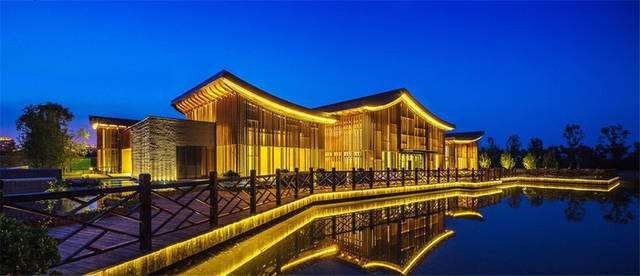
Floodlighting is not simply to reproduce the daytime image of the building, but to use the means of light, color and shadow of flood lighting to reshape the building's more moving, pretty and majestic image at night.
Architectural outline lighting is to use linear light sources (string lights, neon lights, melamine lamps, light guides, LED light strips, whole-body light-emitting optical fibers, etc.) to directly outline the architectural outline. Illuminating the edge of a building with a narrow beam of light can also be used to outline.
Flood lighting outlines contour lighting Internal light-transmitting lighting is the use of indoor light or lamps installed in special positions to transmit light from the inside of the building to form a delicate and translucent night scene lighting effect.

2. Night lighting of the square
The shape and area of the square are both amorphous and various. The lighting must be set to meet the functional lighting as the premise. According to the inherent characteristics of the square, the function of the square should be fully utilized.
Square landscape lighting, first of all, unify the landscape lighting of the buildings around the square and the lighting of the square, coordinate the lighting of the square and the roads around the square, and unify the inherent culture.
Square lighting mainly includes: fountains, square ground and markers, tree arrays, entrance and exit lights of underground shopping malls or subways, and ambient lighting such as surrounding green spaces and flower beds.
3. Night lighting of the bridge

Modern bridges are mostly modern steel cable-stayed bridges, including double-pylon cable-stayed and single-pylon cable-stayed. The shape of the cable-stayed bridge is characterized by the cables. The lighting of the bridge will focus on highlighting this feature, using different lamps and unique artistic techniques, a huge harp stands on the river and the river.