

For B2B decision-makers in industries like outdoor advertising, cultural tourism, and smart city construction, investing in outdoor display equipment is never a casual choice. It requires weighing upfront costs, long-term operational expenses, revenue potential, and even policy compliance. In 2026, as the outdoor LED display market evolves toward high brightness, energy efficiency, and creative customization , a critical question arises: Is flexible mesh screen a worthy investment compared to traditional rigid LED screens? Today, we will help you step by step disassemble it from a rational decision-making perspective.

Part 1: Why has flexible Led mesh screen become an investment hotspot in 2026?
Let's start with a big background: the global LED display market is expected to reach $150 billion by 2025 (according to Statista data), with the proportion of flexible grid screens jumping from 12% in 2024 to 21%. Why? Due to the wave of urban renewal, the pain points of traditional box screens being "bulky, light blocking, and high maintenance" are becoming increasingly apparent, while flexible grid screens are known for their "light transparency, cost-effectiveness, and durability".
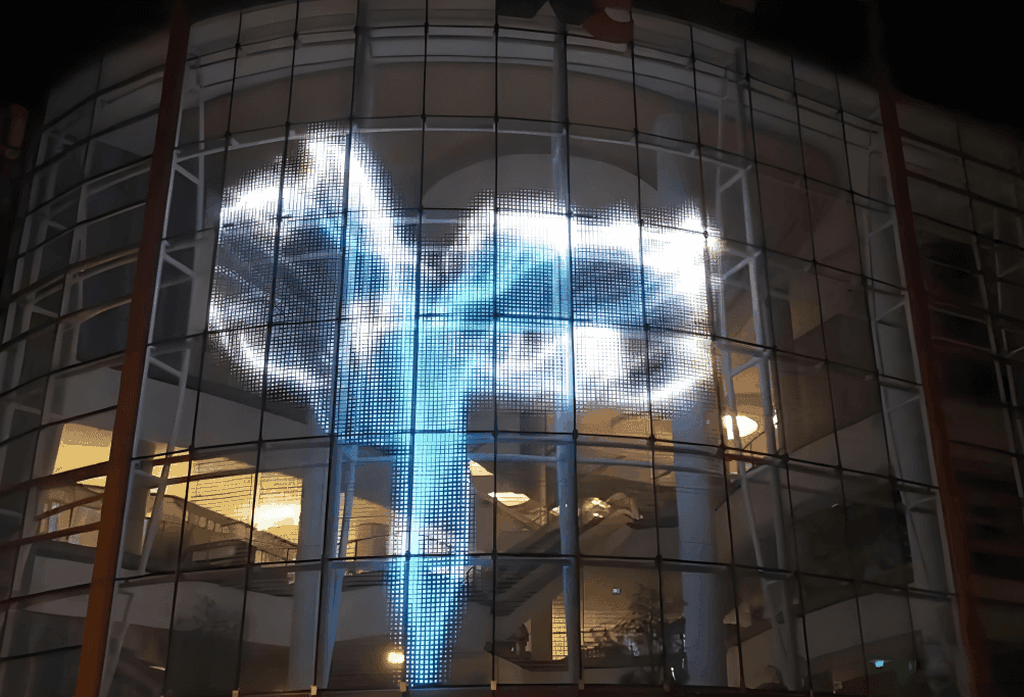
Simply put, a flexible grid screen is an outdoor display mesh screen that is rollable and highly transparent (90%+), designed specifically for building facades, glass curtain walls, water surfaces/underwater scenes. Compared to traditional box screens (enclosed aluminum box+fan cooling), its initial investment is slightly higher, but its long-term ROI can be increased by 30% -50%. Let's talk about data below.
Part 2: Initial Investment Comparison - Who is More 'Expensive'?
B-end customers are often most concerned about upfront costs. We assume a standard project: a 1000 square meter outdoor display screen installed on the facade of a commercial building. Based on the average market price in 2025 (LED Display Factory report: traditional box screen $8000- $10000/set, flexible screen $1000- $1500/set, calculated in square meters, including controller and installation accessories).
The initial investment in traditional box screens has broken down:
Hardware cost: P10 outdoor box screen, with an average price of $1000-1200/㎡ (including power supply and control card). 1000 square meters, totaling $1000000 to $1200000.
Installation cost: requires steel structure frame ($500-600/㎡), tower crane/scaffolding rental (starting at $10000), construction period of 4-8 weeks. Total $60000- $70000.
Other: Planning approval (increased load, $20000), power capacity expansion (high power consumption, $10000).
Total initial investment: approximately $110000- $130000 (excluding shipping and customs duties).
Pain point: The box weighs 35-65kg/㎡ and requires the addition of steel keel, making the application process complicated; Installing a building closure will affect rental income (assuming an office building with a weekly loss of $10000).
Initial investment in flexible grid screen breakdown:
Hardware cost: P50 flexible led mesh screen (mainstream in 2025), with an average price of $300-350/㎡ (including integrated control box). 1000 square meters total $300000- $3.50000.
Installation cost: The weight is only 4.9kg/m2, and no additional steel structure is required. It can be directly attached to the original curtain wall ($100-200/㎡), fixed with steel wire rope buckles and U-shaped butterfly clips, and the construction period is 3-4 weeks. The total amount is between $10000 and $20000.
Other: No load approval required ($0), low power capacity increase ($10000).
Total initial investment: approximately $3100000- $4000000.
On the surface, flexible grid screen hardware is 20% -30% more expensive, but installation saves 60% -70%, and the total investment is the same or slightly lower. The key is that the flexible screen is not sealed off, and the rental loss during the installation period is nearly zero. More importantly, the "invisible design" of flexible screens (with a light transmittance of 90%+) will not lead to a decrease in indoor lighting, and the rent will not decrease (traditional screens may reduce lighting by 30% -40%, and the rent may decrease by 10%).
Summary: In terms of initial investment, flexible grid screens are "expensive in hardware, cheap in installation". If your project budget is tight but you value quick deployment, the TCO (Total Cost of Ownership) of flexible screens is better.

Part 3: Comparison of Long term Returns - Who is More 'Earning'?
The core of investment return lies in the long term. Assuming the screen operates for 12 hours a day, calculate maintenance, electricity bills, revenue, etc. during its lifespan. We use a simple model: ROI=(Total Revenue - Total Cost)/Total Cost x 100%. Based on 2025 data (Radiant report: flexible screen power consumption 280-360W/㎡, traditional 500-980W/㎡; Lifespan of 50000 hours vs. 60000 hours.
Long term cost of traditional box screen:
Electricity cost: power consumption of 780W/㎡, electricity price of $0.15/kWh. Annual electricity cost for 1000 square meters: 780 × 1000 × 12 × 365 × 0.15/1000 ≈ $510000/year. The total amount for 5 years is $250000.
Maintenance: Fan/air conditioner replacement ($50000/year), major repair of LED degradation ($30000 after 3 years). The total amount for 5 years is $2800000- $3000.00.
Lifespan: Tested at 50000-60000 hours (5-7 years), with a post light decay rate of>50%, requiring resubmission.
Total long-term cost: $2850000+over 5 years (excluding depreciation).
Assumption of Revenue: Advertising rental costs $1000/㎡/month (on urban main roads), with an annual revenue of $1.2 million. The total amount for 5 years is $60000000. Net ROI: (60M - initial 2.5M - long-term 3.35M)/2.5M ≈ 21.66 times (annualized 86%).
Long term cost of flexible grid screen:
Electricity fee: Power consumption of 320W/㎡, same as electricity price. Annual electricity bill: 320 × 1000 × 12 × 365 × 0.15/1000 ≈ $210000/year. 5 years total $1050000 (saving 60%).
Maintenance: Natural heat dissipation without air conditioning ($0), single point quick release ($20000/year). Total of $100000- $200000 over 5 years.
Lifespan: Tested at 7000-90000 hours (7-10 years), with slow light decay.
Total long-term cost: $11500000+over 5 years.
Revenue: Same advertising scenario, but flexible screen "invisible+beautiful" increases rental premium by 5% -15% (additional $600000/year). The total amount for 5 years is $63 million. Net ROI: (63M - initial 2.3M - long-term 1.15M)/2.3M ≈ 26.3 times (annualized 105%).
Summary: Flexible screens can save 70% of electricity and maintain 95% over the long term, plus a premium for aesthetics, resulting in a 20% -30% increase in ROI over 5 years. The payback period has been shortened from 18 months for traditional screens to 12 months.
Part 4: Scenario Case 1- ROI Calculation for Advertising Placement
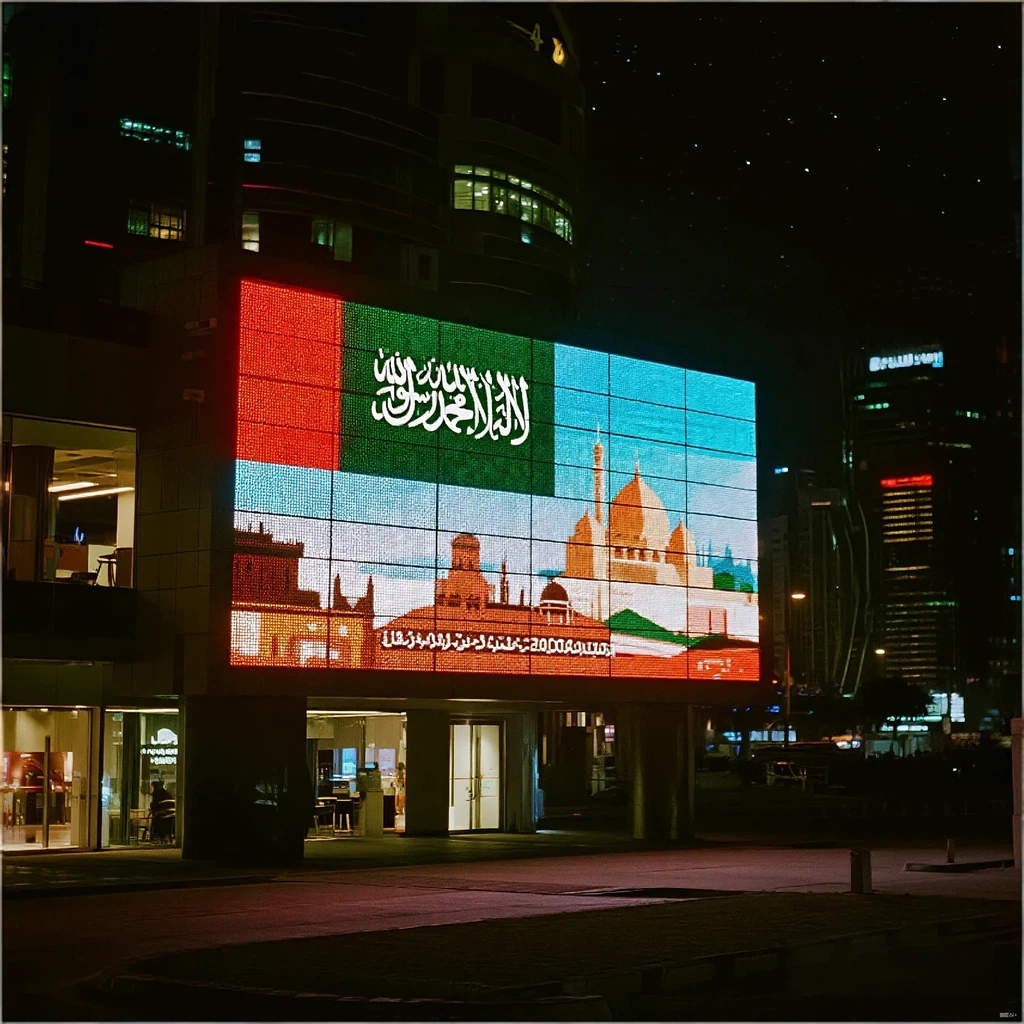
Assuming a 1000 square meter screen on the facade of an office building in Saudi Arabia is used for outdoor advertising rental. Traditional box screens block light and have a high tenant complaint rate; Flexible grid screen with 90% transparency, invisible during the day.
Initial investment: Traditional $2.5M; Flexible $2.3M.
Operating costs: Traditional annual electricity+maintenance $60000; Flexible $10000.
Revenue: Advertising fee of $1200 per square meter per month. $14.4 million annually. But traditional screens have a 60% rental rate ($11520000 per year) due to their ugliness; Flexible 100%+Premium 10% ($15840000 per year).
5-year net profit: Traditional $11.52M/year - $0.61M=$10.91M/year, total $54.55M, ROI 19.82 times.
Flexibility: $15.84M/year - $0.23M/year=$15.61M/year, total $78.05M, ROI 32.89 times.
Flexible screens earn an additional $23.5M with a 66% increase in ROI. Why? Invisible design makes buildings more beautiful, and advertisers are more willing to pay high prices (10% -20% premium).
Part 5: Scenario Case 2- ROI Calculation for Cultural Tourism Drainage
Dubai Global Village project, 5000 square meters+underwater grid screen, used for amusement park light shows. Traditional screens cannot be underwater, have a heavy volume, and cannot achieve IP68; The flexible led mesh screen can be fully installed underwater and is IP68 waterproof. No problem at all
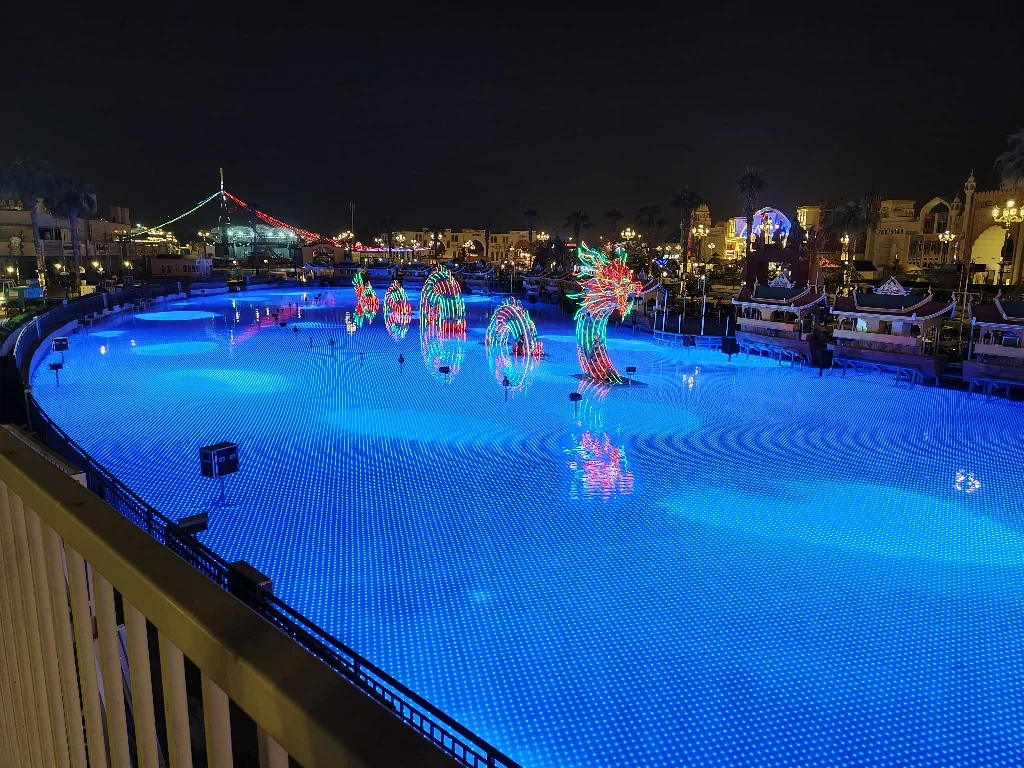
Initial investment: Traditional (onshore) $2.8M (with waterproofing $300k); Flexible $2.4M (water optimization).
Operating cost: Traditional annual $650000 (air conditioning+maintenance); Flexible $0 (natural heat dissipation).
Revenue: Tickets+peripheral consumption. Traditional drainage of 100000 yuan/month ($120000 per year, $10 per person); Flexibility attracts 150000 yuan/month ($180000 per year, with a premium of 50%) due to the "water wonders".
5-year net profit: Traditional $1.2M/year - $0.65M=$0.55M/year, total $2.75M, ROI 0.98 times (barely recouping costs).
Flexibility: $1.8M/year - $0.25M=$1.55M/year, total $7.75M, ROI 3.23 times.
Flexible screens earn an extra $5M with a 230% ROI. Key: In the cultural and tourism scene, the flexible screen's "alien+interactive" feature increases the check-in rate by 30% and doubles the surrounding consumption.
Part 6: Risks and Suggestions - How to Maximize ROI?
Risk: Flexible screen hardware is initially expensive, and if the project cycle is short (<3 years), the ROI will be low. Suggestion: Choose a flexible grid screen (with high cost-effectiveness); Reduce wires with a centralized control box;
Conclusion: In 2026, flexible Mesh screens are definitely worth buying
Data speaking: Flexible mesh screens are initially affordable, with long-term savings of 50% -70% and high ROI of 20% -200%. If you pursue rational investment, it is not a 'new toy', but a 'money making machine'. Contact us for free ROI calculation of your project!